How to Prepare for a Home–School Communication Goals Meeting
A privacy-conscious meeting agenda and worksheet for parents, school teams and speech-language services.
Published by Langley Speech Therapy Inc. • Updated October 25, 2026
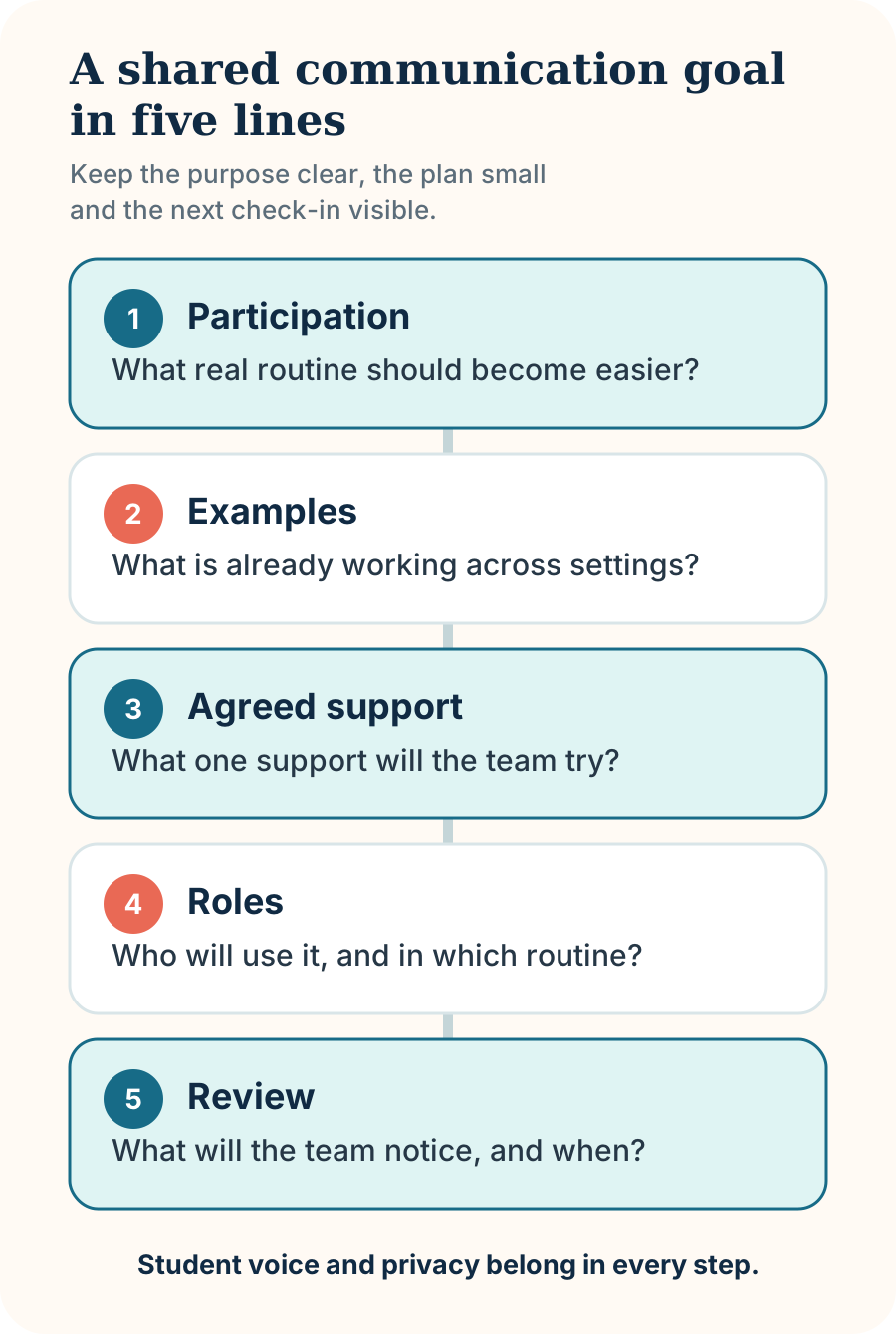
Start with the meeting purpose
Write one sentence about the decision the team needs to make. It might be choosing a communication opportunity to support, agreeing how a tool will be available across settings or deciding what observation to collect before the next review. This keeps the meeting practical without turning a diagnosis or test score into the goal.
Bring two short examples, including one success
A caregiver might note what helped during homework or a family routine. A teacher might describe what happened during group work or a transition. Include a situation where communication worked well as well as one barrier. These are observations for discussion, not proof that a child has or does not have a communication disorder.
Ask for the student’s view before the meeting
When possible, ask what the student wants to make easier, what support feels helpful and how they prefer adults to respond. Communication may be spoken, signed, gestured, pictured, typed or generated by a device. Record the student’s words or communication accurately rather than interpreting them into a goal without discussion.
Use a short agenda during the meeting
Confirm the participation priority, hear each setting’s examples, agree on one support, name who will do what and choose a review date. BC guidance says parents—and, where appropriate, students—must be offered an opportunity to be consulted about a student’s educational program. The school’s documented process still controls any formal plan.
Finish with a read-back
Before the meeting ends, read back the agreed support, roles, routine and review date. Ask what will be recorded in the school plan, what remains a clinical recommendation and who will send the summary. The same goal can look different at home and school; consistency means sharing the purpose, not making every routine identical.
Protect privacy when sharing
Use the school’s and clinician’s approved channels for personal information. Confirm the purpose, recipient and consent before records, reports, photos, audio or video are shared. Do not paste an education plan, diagnosis, health record or identifying details into website chat.
Know what this worksheet cannot do
This guide does not create or change an Individual Education Plan, prescribe therapy, assign school services or replace a school district’s documented process. A regulated professional should make clinical recommendations for an individual child, and families can verify a BC speech-language pathologist in the provincial regulator’s public registry.
Before, during and after: a one-page meeting sheet
Before the meeting
- Participation: What does the student want or need to do in a real routine?
- Examples: What is already working, and where is the barrier?
- Student voice: What does the student say or show about the situation and preferred support?
During the meeting
- Agreed support: What one cue, tool or environment change will the team try?
- Roles: Who will use it, and in which routine?
After the meeting
- Summary: Who will record and share the agreed plan through the approved channel?
- Review: What short observation will the team bring back, and on what date?
Privacy prompt: Before sharing a report or recording, confirm the purpose, recipient, consent and approved channel.
Sources & further reading
Province of British Columbia: inclusive education and American Speech-Language-Hearing Association: collaborative goal writing and College of Health and Care Professionals of BC: public registry. These independent professional and regulatory resources provide background for this guide; they do not endorse this practice.
Published by Langley Speech Therapy Inc. • Updated October 25, 2026. This general guide is not a documented clinician-reviewed assessment or a diagnosis. Ask your treating speech-language pathologist how this information applies to your child.
Important note
This article is general education and does not replace an individualized assessment, diagnosis or medical advice.